What foreign language to learn

What foreign language to learn

I have been asked this question many times and here, I will try to give my perception on the languages that could suit best your personal or job expectations.


Despite learning any language could be extremely useful for certain people, I am going to focus only on five languages and, of course, the reasons for this selection will be provided.

I will not include English as I’m taking for granted that everyone should know at least English. Check this post Why learning a second language to know the importance of learning English and, at the same time, have an insight about becoming proficient in another language.

 

With that being said, let’s get started in alphabetical order!

French

Hindi

Mandarin Chinese

Russian

Spanish


French


French is still considered an influential language although in a less degree than in the past. It’s part of romance family languages which makes easier for native speakers of Spanish, Portuguese, Italian or Romanian to learn French much easier.

French is the official language of the United Nations, the Red Cross, Olympic Games and other international organizations, and a key language for business, research and technological achievements.

Have you ever thought in working for an international company? Many people would like to, and I am sure you are not the exception. Alright. Then, by learning French, you will start gaining solid justification not only to get a job but much better to transcend in your field by creating harmonious relationships in either the business, political, economic or scientific field.

Hindi


Like China, India has a fast-growing economy in different sectors which require intervention of both local and foreign resources.

India is an ancient and culturally-rich country where Hindi is one of the several official languages, which is used by the government and around 300 million people speak Hindi as their first language.

Tourism, Business, Science and technology are areas where speakers of Hindi will play a crucial role to get directly involved in this rapid and diverse development.

Hindi derives from Sanskrit and belongs to the Indo-European family. That means, it shares some similarities with Romance languages, so learning Hindi is, I wouldn’t say much easier, less difficult for people who Indo-Aryan languages or speak Spanish, Portuguese, French, Italian or Romanian.

In any case, as it’s also applicable to learning any language, if you want to learn Hindi, motivation, discipline and practice are unavoidable requirements.

Mandarin Chinese


Chinese language itself is considered a group of languages spoken in Mainland China and the regions under China’s sovereignty; however, I am only going to talk about Mandarin Chinese which is the official language of the government, news and schools.

Due to the fast-growing development of Chinese economy, Mandarin has become a very useful language for many foreigners who want to start any kind of relationship with China. Despite there are many other dialects spoken throughout China, learning Mandarin will be enough to understand and learn about this enriching culture.

According to ethnologue, more than 1000 million people speak Mandarin Chinese as their first language, and this number is gradually increasing which makes Mandarin attractive to learn and interact with a large number of people.

Many people are intimidated by news on the difficulty to learn Mandarin Chinese. By experience, I have my view on it. For more information, you can read this post: Learning Chinese language: Impossible

 

Spanish

It’s a highly phonetical language, so most of words are pronounced are they are written although the opposite is not always the case.

Spanish is spoken by more than 400 people from different countries in 3 continents: America, Europe and Africa. That is a remarkable factor to encourage foreigners to learn Spanish. Despite local idioms in each country, the grammar and general vocabulary are standard and can be understood or deduced by contexts.

There is an official entity that provides guidance and rules on professional writing in Spanish: www.rae.es.

This entity has members from each of the Spanish speaking countries which participate with ideas, suggestions or recommendations on how to improve the Spanish language active and promptly adjusting to society changes. 

By being part of romance languages, Spanish speakers can learn much easier such languages.

It’s true that most countries where Spanish is their official language are considered developing countries; however, this situation is progressively changing and when that moment arrives, the significance of this beautiful language will be evident.

Furthermore, there are more than 50 million people speaking Spanish in the United States which consequently generates more job opportunities for bilingual people and even more for highly-qualified professionals in other disciplines who are also bilingual.


German


German is a language of great popularity not only in Europe but all over the world and it is spoken by over 100 million people.


Learning German allows people to know more and better about technology, literature, education, music and other disciplines. Students have great potential to receive education of superior quality due to the solid educational programs available in German language.


In regard to job opportunities, several well-known multinational companies are constantly in search of new talents who are able to communicate and conduct business in German. Some of those companies are: BMW, Bayer, Siemens, Bosch, Volkswagen, Daimler AG, Allianz, SAP, among others.


If you are fluent in either English, Spanish, French, Portuguese or Italian, the learning curve of German is smoother due to the similarity in grammar and vocabulary. However, this doesn’t mean it’s easy or great efforts are not required. What I actually want to highlight is that those native speakers of the Romance languages may encounter at the beginning some level of resemblance which will boost their confidence to move forward.

In any case, anyone can learn German as long as there is permanent commitment to overcome the unavoidable obstacles inherent to any activity performed. 


Bottom line


Regardless which language you decide to learn, it would be a paradisaical or torturous journey based on what you do and how you do with your learning involvement. Remember that nothing worthwhile is easy and you have to allocate time to study. If you have a strong motivation, then this time studying the language will turn out into a relaxation adventure. This is what I have experienced myself and others in the same circumstances I have had the opportunity to exchange thoughts with.  

I want to clearly state that English and the previous five languages I talked about are only the suggested languages to learn for many people; however, there are specific cases in which other languages are the best options.


Some examples:


  • If your spouse is Brazilian and you are not, it would be wiser for you to learn Portuguese to live and work in Brazil.
  • For automotive engineers learning German or Japanese is a great option
  • If you want to find your beloved in another country, many problems would be avoided by learning their native language


If you have some experiences or opinions in this regard, please share them on the comments below, so we can all learn from each other.

  • How many languages do you speak proficiently?
  • What language or languages will displace English as the international language?
  • With artificial intelligence developments, do you foresee bilingualism still necessary in the near future?
  • Is there any other language as potential “must” learn?

Get the book about China!


Get it now!

(See Table of Content)


Get the book about All Prepositions in Spanish!

Get it now!

(See Table of Content)


Get the book about 1100 English-Spanish Cognates!

Bonus:  Audio pronunciations

Get it now!

(See Table of Content)
 

Paroxytone words (Graves)

Paroxytone words (Graves)

Syllable: It’s a unit of pronunciation with a vowel sound.

Accent (prosodic): It’s the highest stress made on a syllable

Diacritical mark: It’s the visible mark made on a vowel. It’s commonly known as written accent (Only one diacritical mark per word is correct in Spanish).


Note: In Spanish, all words have prosodic accent but not all words have diacritical mark or written accent.

 Some words have two prosodic accents, such as the words ended in “mente.” Because of these two accents, the words ended in “mente” are neither “agudas”, “graves”, “esdrújulas” nor “sobreesdrújulas.” They are special words.


Examples: activamente, cobardemente, efectivamente, religiosamente, repentinamente.


These rules are applicable only to the words with a single prosodic accent.


Paroxytones words (graves or llanas): They are the words with the stress on the second-to-last (penultimate) syllable. The written accent must be placed when the last letter of the word is NOT “n”, “s” or a “vowel”.

               Examples: árbol, lápiz, deuda, pionero, publico.


Important note:


In order to correctly pronounce any word that has no written accent, consider the following rules:


  1. If the last letter of the word is either “n”, “s” or a “vowel”, the stress must be on the penultimate syllable.

               Examples: cosa, casa, ejemplo, gallina, volumen, entonces, certamen, injustamente, abiertamente


  1. In the other cases, the stress must be on the last syllable.

               Examples: analizar, pared, arroz, virtud,


Get the book about Spanish DELE Exam - Level A1!


Get it now!

(See Table of Content)


Get the book about Spanish DELE Exam - Level A2!


Get it now!

(See Table of Content)


Get the book about Spanish DELE Exam - Level B1!


Get it now!

(See Table of Content)


Get the book about Spanish DELE Exam - Level B2!


Get it now!

(See Table of Content)


Get the book about Spanish DELE Exam - Level C1!


Get it now!

(See Table of Content)


Get the book about Spanish DELE Exam - Level C2!


Get it now!

(See Table of Content)


Get the book about China!


Get it now!

(See Table of Content)


Get the book about China!

(Spanish Edition)


Get it now!

(See Table of Content)


Get the book about All Prepositions in Spanish!

Get it now!

(See Table of Content)


Get the book about 1100 English-Spanish Cognates!

Bonus:  Audio pronunciations

Get it now!

(See Table of Content)

 

Many say What but few say How

Many say What but few say How

Whatever I am writing here is part of my own experience and that from many people I have read from or interacted directly with.


  • Do you sometimes feel like somebody who tries and retries but things don’t seem to change?
  • Do you often consider yourself as an unlucky person?
  • Are there moments in which you don’t know why your plans render totally unexpected results?
  • Do you recurrently think that other people are happier than you?


Well, if you answered yes to any of the above questions, it means you are a human being and are still alive on this planet; on the contrary, if you answered No to all the previous questions, it means you are a human being, are still alive on this planet but are freaking lying!

The reason is simple: Facing problems, feeling discouraged, confused, hopeless, pessimistic or depressed are just inherent to all of us, as human beings, at certain points of our lives; the difference is that some find the way to manage those feelings and turn them upside-down to take advantage for achieving more.

So, a question may be: “Is it easy to take advantage of those feelings?”

The answer is easy: “No”.

I have read quite a lot about the problems that people have or might have, as well as what to do or what not to do in different facets of our lives; I consider this information very fruitful in terms of helping us to identify our perils or weaknesses.

However, it’s less common to find practical techniques that focus exclusively in explaining how we can solve our problems or achieve our goals regardless of the circumstances we may have.

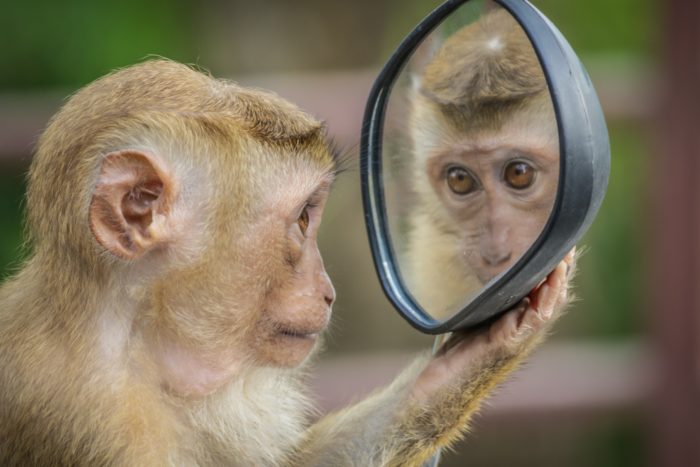
Now, I’m going to describe a technique that I first read on the book The Magic of Believing by Claude M. Bristol and it’s been shared in other publications as well. This is called “The Mirror technique”.


Before moving forward, I would like to highlight that we must believe in something and then take actions to experience it ourselves. This is exactly what I did with the “The Mirror technique”. Based on the directions of the author, I tried it myself and proved it very effective.

Here is one of many achievements I have got by using this approach:

Several years ago, I read on a website for local information about scholarships abroad and caught my attention one related to studies in Japan. Immediately, I started to take notes on the requirements and researched everything I could about Japan.

That scholarship was directed to teachers to study in Japan for 1 year about technology and education. It covered everything!

With everything I mean: Flight tickets (first class), accommodation, food, tuition, local transportation, local study trips, special cultural events and a monthly stipend for other expenses. For me, getting that scholarship was better than winning the lottery as I was financially restricted.

So, the mirror technique came to my mind. “I can use this technique to get the scholarship”, was my reflection. So, I started to take actions.

One of the hardest requirements was to know English at an intermediate level (speaking, listening, reading and writing). Before, I had been taking some English courses, so I devoted 3 hours a day to intensify the learning process and to take later an official English Language Test like IELTS or TOEFL.

It took me around 3 months intensively studying until I finally took the IELTS. What a great joy because I got a good score!

I collected all the documents required and submit the application to get the scholarship. In the meantime, I started to use the mirror technique:

Every morning, noon and night, I was doing this:

  • Standing in front of a mirror
  • Looking at myself directly to my eyes and thinking, “I am going to get the scholarship to Japan. This is wonderful, terrific and I deserve it. Thanks God for everything!”
  • For around 5 minutes, I was repeating this with a strong belief that I would get it. I was visualizing the entire process of going to Japan, mentally “seeing” with complete happiness everything that I have read about Japan.
  • One factor I consider fundamental was  that the mental visualization I was having was tremendously intense. The more I thought and repeated this declaration, the more confident I felt
  • I followed this process religiously un-interrupted for 2 months.

After 2 months, I received the letter with the result of my application: “Thank you very much but we have chosen another candidate. We encourage you to continue applying in the future.”

For around 1 minute I felt my world had collapsed as my commitment to get it was serious. But yes! It lasted only 1 minute because I recovered, refueled myself with more energy and restarted the process.

Six months later, I applied again and was rejected for the second time; however, I wasn’t a novice anymore on receiving bad news, and therefore this “failure” didn’t affect me much as the first time.

I continued using the mirror technique with more optimism and applied for the third time to get the scholarship.

Can you guess what the letter with the results of my third application said?

Yes, I was accepted, and I traveled to Japan!

The joy experienced at that moment was inexpressible!

Since then, I have been applying the mirror technique to obtain a lot of accomplishments. The technique has worked for me and for many; therefore, it can also work for you!


Bottom line


If you have some experiences or opinions in this regard, please share them on the comments below, so we can all learn from each other.

  • Have you ever used the mirror technique?
  • Do you think the mirror technique is effective or luck plays a role?
  • Why do you think not many people achieve their goals?
  • What other ways to get things done do you know?

Oxytones words (Agudas)

Oxytones words (Agudas)

Syllable: It’s a unit of pronunciation with a vowel sound.

Accent (prosodic): It’s the highest stress made on a syllable

Diacritical mark: It’s the visible mark made on a vowel. It’s commonly known as written accent (Only one diacritical mark per word is correct in Spanish).


Note: In Spanish, all words have prosodic accent but not all words have diacritical mark or written accent.

 Some words have two prosodic accents, such as the words ended in “mente.” Because of these two accents, the words ended in “mente” are neither “agudas”, “graves”, “esdrújulas” nor “sobreesdrújulas.” They are special words.


Examples: activamente, cobardemente, efectivamente, religiosamente, repentinamente.


These rules are applicable only to the words with a single prosodic accent.


  1. Oxytones words (Agudas): They are the words with the stress on the last syllable. The written accent must be placed when the last letter of the word is either “n”, “s” or a “vowel”.

               Examples: canción, interés, comió, Canadá, ayer, pared, publicó.


Important note:


In order to correctly pronounce any word that has no written accent, consider the following rules:


  1. If the last letter of the word is either “n”, “s” or a “vowel”, the stress must be on the penultimate syllable.

               Examples: cosa, casa, ejemplo, gallina, volumen, entonces, certamen, injustamente, abiertamente


  1. In the other cases, the stress must be on the last syllable.

               Examples: analizar, pared, arroz, virtud,


Get the book about Spanish DELE Exam - Level A1!


Get it now!

(See Table of Content)


Get the book about Spanish DELE Exam - Level A2!


Get it now!

(See Table of Content)


Get the book about Spanish DELE Exam - Level B1!


Get it now!

(See Table of Content)


Get the book about Spanish DELE Exam - Level B2!


Get it now!

(See Table of Content)


Get the book about Spanish DELE Exam - Level C1!


Get it now!

(See Table of Content)


Get the book about Spanish DELE Exam - Level C2!


Get it now!

(See Table of Content)


Get the book about China!


Get it now!

(See Table of Content)


Get the book about China!

(Spanish Edition)


Get it now!

(See Table of Content)


Get the book about All Prepositions in Spanish!

Get it now!

(See Table of Content)


Get the book about 1100 English-Spanish Cognates!

Bonus:  Audio pronunciations

Get it now!

(See Table of Content)
 

Any place, anyone, anytime

Any place, anyone, anytime


Regardless the place you live, you can accomplish whatever you purposely plan when the right time comes.


I have had the fortune to visit many places in 3 continents and my perceptions have a common denominator: There is variety for everyone!

What I mean is, as William Shakespeare correctly stated: “Beauty is in the eye of the beholder.”

And that’s absolutely true!

At some point, I may consider a place a gorgeous land whereas the very same place signifies a dull atmosphere for another person. “How come?”, you may wonder.

Well, it’s a matter a of perception, mood, aspirations, intentions and, in brief, the way you live your life.

It’s not about the place, but exclusively about the person who is perceiving it.

Any place has its own reason to be attractive, so it’s up to each individual to make a firm decision and try to discover that non-evident or hidden appeal.


By human nature, we all tend to appreciate reiteratively our precious values but only when they are gone. So, the same happens when visiting a new territory. We should acquire the predisposition to find excitement in any single detail. It’s not a random activity but a planned one that must be practiced persistently in order to transform it into a habit.

I know, it’s not an easy task. Well, nothing meaningful is easy. Always consider this and start complaining less and enjoying more.

I am curious when read on Internet forums about the best places to visit, and people start giving their opinions based on their own experiences or preferences. As I mentioned it before, it’s not about the places but closely tight to the person who wants to explore new adventures.

Let’s take as an example, museums. In those Internet forums, it’s very common to read strong recommendations for famous museums or galleries. That’s perfect for an artist or a person that enjoy history, sculptures or art in general.

Personally, I don’t spend much time in museums when visiting a touristic place. That doesn’t mean I cannot recommend them because there are many who will find them useful and feel indeed pleasurable moments.


Another common aspect is the weather. Traditionally, the tourist industry has its peaks in summer time, so don’t get surprised if you hear or read something like, “This city is wonderful, but only in summer.” The first time I heard this, I immediately wondered, “Why?”

Does it mean the rest of year people cannot enjoy the different attractions any city has to offer?

For some, the answer would be “yes.” However, for me, any day can be the best opportunity to break traditions, the status quo, and to start a new quest that, if you have a steady conviction, can be converted into magnificent and unforgettable occasions. 

At any moment, especially when travelling, safety is a crucial factor to consider. Because of media, some places are “banned” for tourists due to the “high risk” of being affected by violent events. That’s true in some cases, but believe me, that’s clearly unfair to generalize an entire nation for some isolated insecurity-related cases. 

For your information, I have visited many times those places where “supposedly” you can enter but won’t leave alive or healthy. The result? Here I am with no even a single signal of any kind of perturbation whatsoever.

So, remember the next time you are planning your vacations, use Google of course, but don’t believe everything blindly; use your judgement to choose whatever meets your expectation and go even further: Do something new because, many times, pleasure resides on simplicity and exploration.


 Bottom line

Any place, anyone, anytime. Anyone can visit any place anytime to have remarkable sets of events.

If you have some experiences or opinions in this regard, please share them on the comments below, so we can all learn from each other.


  • Have you ever travelled abroad?
  • Do you think places are not what most people say they are?
  • In your opinion, what do we need to enjoy our trips?
  • Do you believe that there is everything for everyone?
  • What are the best places you have visited and why?


Get the book about China!


Get it now!

(See Table of Content)


Get the book about All Prepositions in Spanish!

Get it now!

(See Table of Content)


Get the book about 1100 English-Spanish Cognates!

Bonus:  Audio pronunciations

Get it now!

(See Table of Content)
 

error: Content is protected !!